

SHOCKING GALLUP POLL: Compound Users Rate Medication Effectiveness Higher than Branded!

For the past several years, the obesity conversation has centered on one thing: better medications. Every major scientific meeting introduces another molecule with greater weight loss, another receptor target, another promise that the next generation of therapies will outperform the last. Innovation has been breathtaking, and the pipeline has never looked stronger. But after reading a new Gallup survey this week, I found myself wondering whether we’ve been measuring the wrong thing all along.
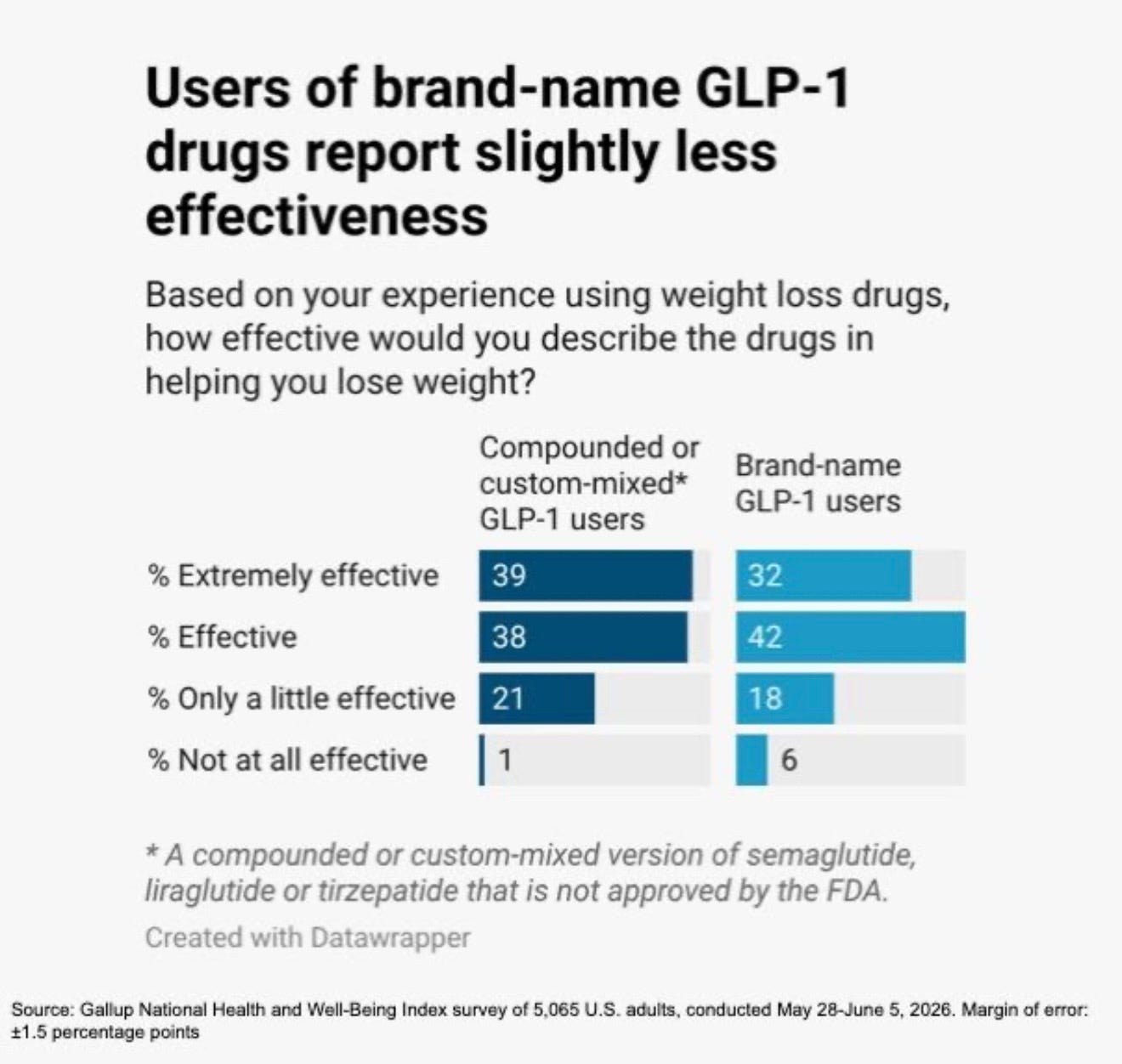
The survey included more than 5,000 people taking GLP-1 medications and produced a result that immediately ignited debate across social media. Patients taking compounded GLP-1s reported higher rates of being “extremely satisfied” with their treatment than those taking branded medications. Predictably, many people rushed to frame the results as evidence that compounded medications somehow work better than FDA-approved products. I don’t believe that’s what this survey is telling us.
Instead, I think Gallup may have accidentally uncovered something far more important. What if patients weren’t actually rating the medication? What if they were rating the experience of receiving care?
For decades, obesity medicine has often been reduced to a prescription written during a brief office visit, followed by little education, minimal follow-up, and a patient left to navigate one of the most complex chronic diseases on their own. Telehealth, despite its imperfections, has approached the problem differently. The best organizations have built ecosystems around the patient, combining education, coaching, technology, communication, laboratory monitoring, and personalized treatment plans into a single experience. When patients say their treatment has been effective, perhaps they aren’t simply talking about pounds lost. Perhaps they’re talking about finally feeling supported.
That question became deeply personal for me this year. After intentionally coming off my medication during Lent, I regained nearly twenty pounds despite maintaining a disciplined diet and consistent exercise routine. It was a frustrating reminder that obesity is not simply a disease of effort, and that trying harder is rarely the answer. When it came time to restart treatment, I realized I wasn’t looking for another prescription. I was looking for someone who understood my story well enough to build a treatment plan around it.
That journey ultimately changed the way I think about obesity medicine. Today, I’m back near my lowest weight while using less than one-third of the GLP-1 dose I previously required. The difference wasn’t finding a stronger medication. It was finding a more personalized approach that looked beyond a single pathway and treated the whole patient instead of simply escalating the dose.
This week’s episode of the On The Pen Weekly Dose Podcast explores why I believe the Gallup survey is being misunderstood, what it reveals about the future of obesity care, and why the next breakthrough may not come from another molecule at all. It may come from finally delivering the kind of personalized care patients have needed all along.
If you’ve ever felt like your prescription was only one small piece of a much bigger puzzle, I think this conversation will resonate with you. I’d love to hear your thoughts after you listen. Do you think patients are rating the medication, or are they finally rating what it feels like to receive the care they’ve deserved all along?
I’ve been on both. I think the compounded is often stronger, depending on the pharmacy, but I have lost on both. I actually prefer compounded since my insurance doesn’t cover the kiwikpens or vials. If Lilly would release the multidose vials and my insurance would cover them, I might like brand better since I could customize my doses easier.
Are people getting overdosed?