

A Molecular Stapler Could Make GLP-1 Drugs Last Longer. Scientists Borrowed It From Bacteria.

The body has always known something drug developers are still learning: shape matters.
Not just the shape of a molecule as it enters a receptor, but the shape it holds after hours in the bloodstream, after the body has done everything it does to break things down. For the millions of people on semaglutide, tirzepatide, or retatrutide, the drugs work. But the question researchers keep returning to is whether they can work better, last longer, and hold their shape more completely against the body’s own cleanup systems.
A team at the University of Utah thinks a bacterial enzyme that almost no one was paying attention to might be part of the answer.
The lock, the key, and what happens to the key over time
GLP-1 medications work like a key fitting into a lock. The receptor sitting on your cells is the lock. The drug is the key. When the key fits precisely into the lock, it triggers a cascade of signals that reduce appetite, slow digestion, and help regulate blood sugar. The whole system depends on that key holding its shape long enough to do its job.
The problem is that the body is constantly trying to take the key apart. Peptide drugs like semaglutide are short chains of amino acids, the same building blocks that make up proteins, and the body recognizes them as something to be digested and cleared. Drug manufacturers have gotten creative about slowing that process. Semaglutide, for example, has a long fatty acid chain attached to it that helps it hitch a ride on a blood protein called albumin, buying it enough time to last a full week before the next dose. But even with that protection, the body still attacks the drug from its tail end, using enzymes called exoproteases that chew through the peptide chain starting at one end and working inward. The key, in other words, is always being worn down. The goal is to make it more durable.
What PapB does, and why researchers got excited
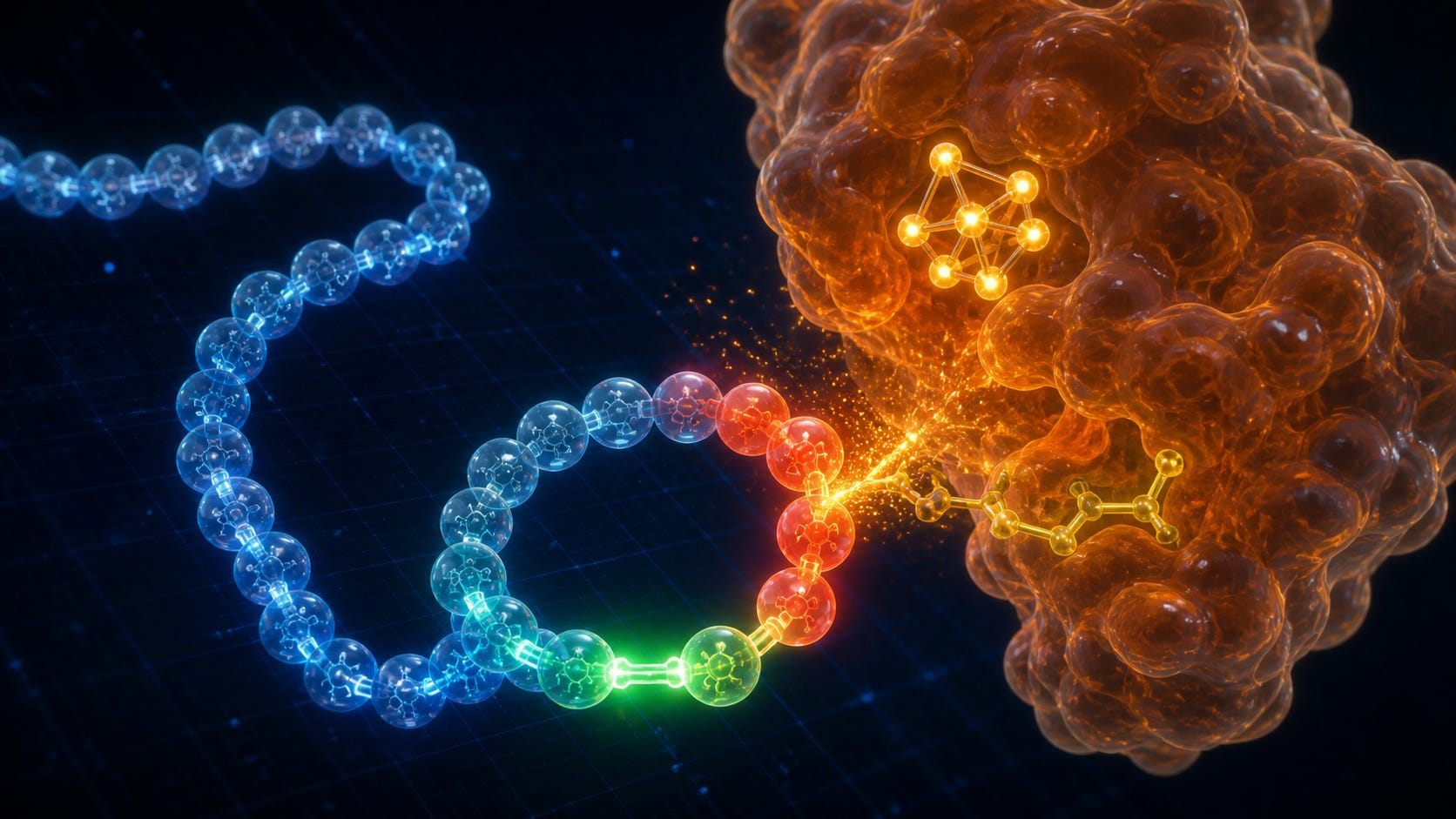
The enzyme at the center of this research is called PapB. It comes from bacteria, and it belongs to a class of natural molecular machines that bacteria use to sculpt small protein chains into closed ring shapes, a process called macrocyclization. The way to picture it is this: instead of leaving the tail end of the key exposed and vulnerable, PapB acts as a molecular stapler that loops the tail back and snaps it into a closed ring. An exoprotease trying to attack from that end suddenly has nowhere to grab. The key holds its shape longer. It stays in the lock.
The scientific community knew PapB existed, but it was considered too finicky to be broadly useful as a drug development tool. The enzyme was believed to require a specific recognition tag attached to any peptide it would work on, a kind of molecular return address called a leader sequence. Without that tag, PapB was thought to simply ignore the peptide. Using it in practice therefore meant attaching the tag, running the stapling reaction, and then chemically cutting the tag back off, a process that added steps, added cost, and limited which peptides it could realistically be used on.
The Utah team, led by chemist Vahe Bandarian, decided to test just how strict that requirement actually was. They fed PapB peptides with the wrong tag. Then peptides with a completely foreign tag from an unrelated biological system. Then peptides with no tag at all. In every case, PapB formed the ring anyway. The leader sequence was not the strict gatekeeper the field had assumed. As the authors wrote in ACS Bio and Med Chem Au in October 2025, PapB turns out to be a “plug-and-play biocatalyst” that works across a remarkably wide range of molecular inputs.
Testing it directly on GLP-1 drug analogs
Once the team established that PapB was far more flexible than expected, they moved to the obvious next question for readers of On The Pen: would it work on peptides that look like the GLP-1 drugs people are actually taking?
They built close laboratory analogs of semaglutide, tirzepatide, and retatrutide, preserving the pharmacologically active cores of each drug while leaving off the fatty acid chains used for extended release. To the tail end of each peptide, they attached a short additional sequence that PapB could recognize and staple into a ring. When they added the enzyme, it completed the ring on all three analogs, every single time, with nothing left unreacted. In laboratory terms, that is a perfect result.
That closed ring at the tail end of the peptide does several things worth understanding. It blocks the exoproteases that would otherwise begin dismantling the key from that end. It also stiffens the tail of the molecule, reducing the kind of loose molecular movement that can make a key fit less precisely into its lock. And it creates a new chemical attachment point that researchers could potentially use to carry additional modifications, whether that means helping the drug last longer in the body, directing it toward specific tissues, or other improvements to how it behaves over time.
Why this matters beyond the laboratory
Living with obesity means living with a biology that resists change, not out of stubbornness, but out of deep evolutionary programming the body mistakes for survival. The drugs that have transformed treatment over the past several years work because they speak a language the body already understands. They do not force a door open. They fit the lock.
What PapB could eventually contribute to that story is persistence. Every time a GLP-1 drug breaks down faster than intended, every time the body clears it before the next injection is due, there is a gap in that conversation between drug and receptor. A ring at the tail of the key is a structural answer to that gap. It is the key being given a shape the body cannot as easily dissolve. That matters in a clinical sense for dosing and efficacy. It matters in a human sense for the people whose lives are organized around injection day and whether the medication is still holding.
Where things stand now
Bandarian and co-author Karsten Eastman have disclosed the findings to the University of Utah and co-founded a company called Sethera Therapeutics built around this enzyme platform. The research was funded by the National Institute of General Medical Sciences, part of the National Institutes of Health.
This work is proof of concept, meaning it is a meaningful early step but not a finished drug. The GLP-1 analogs used in the experiments were stripped of their fatty acid chains, so they are not identical to the medications currently on the market. Whether PapB can be applied to the full clinical compounds, and whether the ring-shaped structures it creates show meaningfully better performance in animal studies or human trials, has not yet been established. Those are the questions that come next.
What has been established is that an enzyme borrowed from bacteria, one the field had largely set aside as too limited to be useful, works on almost anything researchers put in front of it. It can close a ring at the tail end of the keys that have already changed how medicine thinks about obesity. The question now is whether that ring can help those keys stay in the lock a little longer.
Source: Pedigo JK et al. (2025). Leader-independent C-terminal modification enables macrocyclic GLP-1-like peptides. ACS Bio & Med Chem Au. https://doi.org/10.1021/acsbiomedchemau.5c00152
I’m literally on the U of U campus while reading this, they are brilliant here! Thanks for the break down of this Dave!
What a beautiful explanation! Thanks!